Uncategorized

Solidarity Among Media Workers for Better Journalism

foto: SMCG
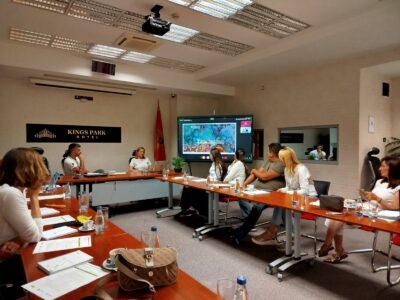
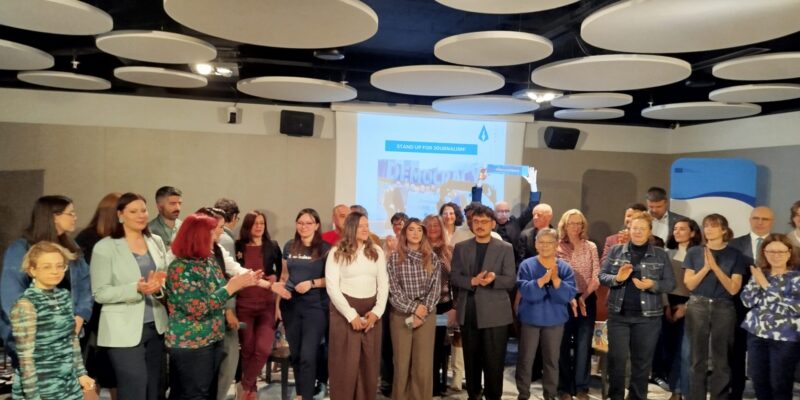
Joint action, the exchange of experiences, and mutual support among media workers are key to strengthening the journalism community and creating tangible improvements in working conditions, as emphasized at the two-day conference “Laying the Foundations for the Future of Journalism.”
The workshop, organized by the European Federation of Journalists (EFJ) and the Trade Union of Media of Montenegro (TUMM) on March 26–27 in Podgorica, is part of the Stand Up for Journalism project, financially supported by the European Union.
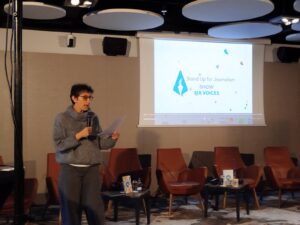
EFJ President Maja Sever said that the daily work of journalists is becoming increasingly difficult, that attacks on journalists are growing, and that journalists are often blamed for everything, facing pressure and a lack of real understanding of their work.

photo: TUMM

“At the same time, our work as journalists and trade union activists has become more demanding. Yet we remain guided by the same principles: we know that journalism serves the public interest and is crucial for citizens’ freedoms and democratic societies”, she added.
That is why, Sever emphasized, they continue their work and firmly stand up for journalism.
“Over the past two years, as the project has been running, we have shown that joint action, experience sharing, and mutual support bring real change and strengthen our community. Solidarity is what connects us and gives us the strength to keep going. Our shared, determined work is also a response to attacks and pressures – a commitment to quality journalism and journalists’ rights, because we know how essential journalism is for every democratic society”, Sever said.
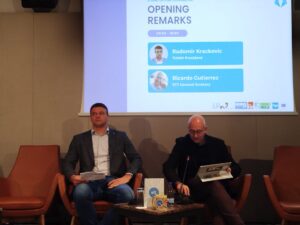
EFJ Secretary-General Ricardo Gutierrez noted that journalists’ organizations are often entirely absorbed by day-to-day operations, leaving little space to step back and take a strategic view of the future or the key issues that could change journalism and, consequently, the way workers in the sector are organized.
He said that times are tough and hostile toward journalism, but even in such worrying scenarios, new forms of collaboration emerge to organize resistance and protect the public interest.
“I believe that this is the spirit that must guide our work today and tomorrow. We must dare to break free from our shackles and imagine new forms of solidarity, using the tools we will discuss during the workshops and talks throughout the program”, Gutierrez said.

photo: TUMM

TUMM President Radomir Kračković said that laying the foundations for the future of journalism requires starting with a fundamental question: in which sort of conditions are journalists working today?
“In Montenegro, the average media worker today is underpaid, overworked, and too often unprotected. According to research by the TUMM and the OSCE Mission, three out of four media workers earn less than the national average. At the same time, many work overtime without proper compensation, facing exhaustion, burnout, and serious mental health consequences”, Kračković said.
He added that journalists work in an increasingly unsafe environment, and that TUMM recorded 33 cases of attacks and threats against media workers just last year – an unfortunate record since the organization began tracking incidents in the SafeJournalists network database.
“That is why at this conference we are not only discussing problems but also solutions: How can we ensure dignified working conditions for all journalists? How can we create a healthy work environment that does not threaten professional integrity or personal dignity? How do we respond to the challenges posed by new technologies? And, of course, how do we involve young journalists in shaping these responses? As the conference title suggests, we are laying the foundations for the future of journalism now”, Kračković said.

Better Conditions for Young Journalists
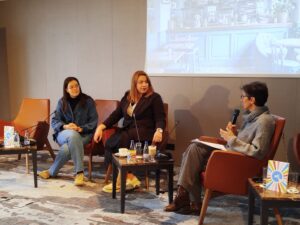
The conference also addressed the position of young journalists in the contemporary media market.
Young journalist Ivana Vlaović, who is also a member of TUMM’s Youth and Freelance Section, said that employer expectations toward newcomers in newsrooms should be more realistic.

photo: TUMM

“Recently, I attended a regional event where they complained that young people are uninterested. At that moment, I thought about how many young journalists are employed under service contracts, working overtime without proper compensation, and earning below-average salaries. If we want quality journalism, we must provide better conditions for young people – adequate working conditions, training, and most importantly, support,” Vlaović said.
Young journalist Lea Jajaš said that her labor rights have been repeatedly violated.
“I belong to Generation Z, and people often speak negatively about us, saying we give up easily, leave jobs without reason, and so on. I would describe us as a generation that knows what it wants. When we see that we are not given the opportunity or that our working time is not respected, we don’t hesitate. It’s okay when a breaking news story happens, but in journalism, worlds collapse every day. I need to have my own world and my own life. That is why I would say that we are a generation that does not allow anyone to humiliate us, neither personally nor professionally,” Jajaš said.

Solidarity as a Prerequisite for Better Working Conditions
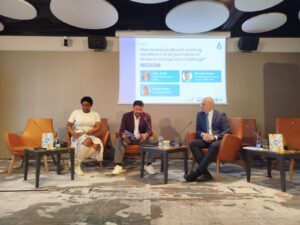
At the panel “How to Ensure Dignified Working Conditions in Times of Change and Challenge,” Rowan Blijd from the Dutch Association of Journalists (NVJ) addressed the situation of freelance journalists, highlighting the union’s success in securing higher fees.
“We reached agreements with major publishers, setting fees at 167% of staff salaries to cover expenses and social contributions, and we also established minimum rates. We achieved this because all media workers fought together and acted in solidarity. For years, we have connected people to ensure they understand that we are all one, and that only through solidarity can we secure rights for everyone in the media industry,” Blijd said.

photo: TUMM

Editor and TV presenter Saša Delić, formerly employed by Al Jazeera Balkans, said he had excellent working conditions there, but everything disappeared when the outlet shut down.
“Now I work at another media outlet, and my conditions are also good, but we are fighting to survive. If you are impartial, if you are professional, it is difficult. We fight daily for our independence, doing many things despite those who want to shut us down. And we must continue, to be vocal and keep working. I believe this profession has a future, as the younger colleagues have explained,” Delić said.

You may also like

Comments are closed.