 By
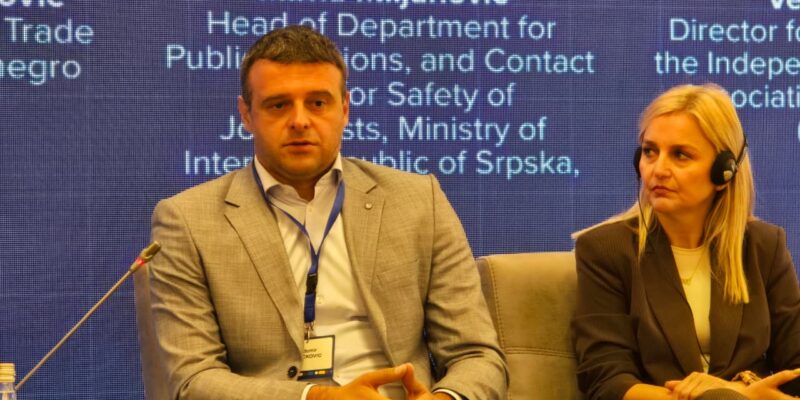
By Although Montenegro is showing greater readiness to respond to attacks on journalists, the rise of hate speech, political polarisation and right-wing rhetoric is leading to a record number of incidents, said Radomir Kračković, President of the Trade Union of Media of Montenegro (TUMM).
Speaking at the OSCE South East Europe Media Conference in Tirana, Kračković said that in recent years more cases of attacks on journalists had reached a legal conclusion than before, but that the most serious cases still remain unresolved.
“Among them are the 2004 murder of journalist Duško Jovanović, where neither the perpetrator nor those who ordered the killing have been identified, as well as the attempted murder of investigative journalist Olivera Lakić in 2018, where the trial is still ongoing eight years after the attack,” Kračković said.
He also recalled last year’s attack on photojournalists Boris Pejović and Stevo Vasiljević, from the daily newspapers Vijesti and Pobjeda, during the removal of a monument to Pavle Đurišić near Berane. He noted that the photojournalists were subjected to threats, physical violence and prevented from carrying out work of public interest, while only two of the attackers were convicted.
Kračković warned that politicians and public officials are often direct instigators of pressure on the media through public discrediting campaigns, SLAPP lawsuits and by encouraging verbal attacks against journalists.
“On the other hand, I must say that in recent years there has been stronger political will within the state to respond more quickly to attacks on journalists and reduce their number. Despite that, Montenegro recorded a record number of attacks last year – 33 in total,” he said.
Speaking about institutional responses, Kračković recalled that Parliament, following an initiative by media organisations, amended the Criminal Code and introduced harsher penalties for attacks on journalists. However, he noted that courts still do not apply a consistent practice, with some cases being reclassified as misdemeanours or ending with lenient sentences.
He also pointed out that this year, with the support of the OSCE Mission and on the initiative of TUMM, an intersectoral working group was established to create a mechanism for the protection and safety of journalists. The mechanism includes rapid institutional response, legal and psychological support for journalists, training for newsrooms and institutions, as well as a free hotline for reporting attacks and pressure.
Kračković dedicated a special part of his address to the position of women journalists, stressing that women accounted for more than half of all registered attacks on journalists in Montenegro last year.
“Out of 18 recorded attacks against women journalists, 12 took place online, showing that the risks faced by women in the media are increasingly shifting into the sphere of digital violence and continuous intimidation,” he added.
He stressed that women journalists are most often targeted with threats, sexist insults, harassment and “doxing” – the publication of private information without consent – which is why the protection of women in the media must include a gender-sensitive approach and a better understanding of digital violence.