 By
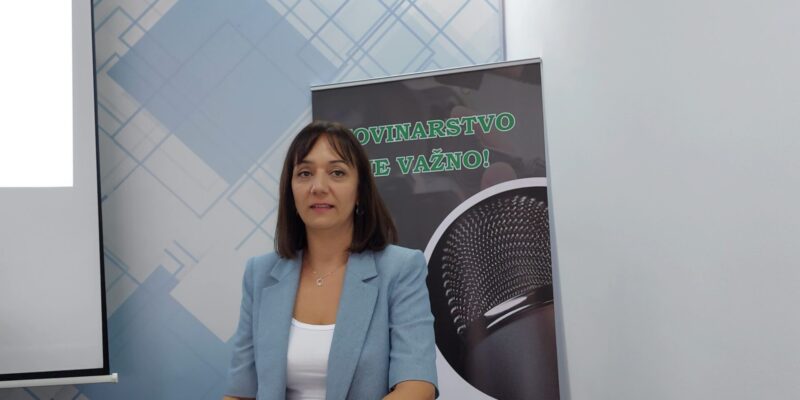
By Long-time journalist, trade union activist and researcher in the fields of media freedom, journalists’ working conditions and media legislation, Marijana Camović Veličković, has been elected the new president of the Trade Union of Media of Montenegro (TUMM).
The decision was made unanimously at the fifth Assembly of the Trade Union of Media of Montenegro, held today and attended by 30 delegates from all trade union organisations operating within TUMM.
The Assembly also elected a new Main Board for the next four-year term. In addition to the president, the Main Board will comprise Tamara Leković and Stevan Filipović (RTCG Employees’ Trade Union), Milan Nikčević (Gradska RTV Trade Union), Boris Pejović (Daily Vijesti Trade Union),
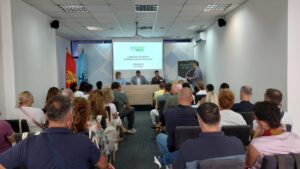
foto: SMCG
Radomir Kračković (TV Vijesti Trade Union), Tatjana Mandić (RTV Budva Trade Union), Dragana Vlaović (RTV Herceg Novi Trade Union), Edin Zuković (RTV Pljevlja Trade Union), Milena Bubanja Obradović (Radio Berane Trade Union), Enes Gusinjac (RTV Rožaje Trade Union), Siniša Sanader (Radio Tivat Trade Union), Eliana Peku (RTV Ulcinj Trade Union), Sonja Lagator (RTV Cetinje Trade Union), as well as, for the first time, a representative of the Youth and Freelancers Section, Ivana Vlaović.
Camović Veličković stressed that the Trade Union of Media of Montenegro must continue to be a safe place for media workers. In her address, she noted that she had been part of TUMM since its establishment and that, as its president, vice-president and employee, she had witnessed its growth and development, as well as the obstacles faced both by the organisation and by individuals fighting on multiple fronts for better working conditions.
“Our struggle is not always visible, and I often wonder whether our members even see our work and whether they approve of it or are indifferent to it. Our work is persistent and principled, and now, almost 14 years since our establishment, we can say that we are present everywhere and that we are making a difference for the better. We do this when it comes to the safety of journalists – just a few days ago, the amended Criminal Code was adopted, containing three new provisions protecting media employees. We do it when it comes to innovation in media and journalism – we talk about artificial intelligence and its impact on the work of the media, but we also continue to fight for the basics: better and more dignified working conditions in the media,” Camović Veličković said.
She said that solidarity among media workers should be the response to the challenges facing the journalism profession today, along with the need to support those who need it.
“Have we done enough, or anything at all, over the past four years to make this profession better and to make things better for the people working in it? I am not referring to trade union organisations or TUMM itself, but to us personally. Do we even know what is happening in our own newsrooms or in other media outlets, and how willing are we to step outside our comfort zones and speak up for someone else? Did we do enough when Milan Nikčević was dismissed? Do you know who he is? When the persecution of trade union members at RTCG began, should we, regardless of which newsroom we came from, have said something? More than 100 people left that union amid unprecedented anti-union discrimination. Are we, as a community, aware of that? Could we have supported them in some way? … Solidarity means ensuring that no one is left alone when a problem arises,” Camović Veličković stressed in her speech.
She added that, despite numerous obstacles, TUMM would not give up on concluding the Branch Collective Agreement, which must bring certain improvements in terms of salaries and working conditions.
“This is also one of Montenegro’s objectives in the EU accession process, and we hope that all stakeholders have finally understood how important this document is. We certainly will not miss this opportunity and will try to conclude the ongoing negotiations on terms that are as favourable as possible for our members. However, even once the Branch Collective Agreement is signed, we cannot stop there. Our goal is also to conclude as many collective agreements as possible at employer level, and we will have to focus on this and invest much more effort.”
Outgoing president Radomir Kračković presented the results of the trade union organisation’s work during the previous term and stressed that the environment in which the Trade Union of Media operated and fought to improve media workers’ rights over the past four years had been extremely complex.
Trade union organisations faced brutal attempts at discreditation and loss of membership. Nevertheless, despite all the challenges, problems and
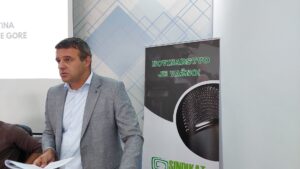
foto: SMCG
obstruction, results were achieved and foundations were laid for further improvements to the status of media workers in the near future. Thanks to trade union action and the public advocacy of individual trade union organisations and TUMM during the previous term, increased compensation for Sunday work was introduced in the media sector, while salaries were increased in a significant number of public and private media outlets, with support from the Union of Free Trade Unions of Montenegro (UFTUM).
Kračković also stressed that the environment for the professional work of journalists and media workers in Montenegro had deteriorated over the previous four years, with almost 100 attacks recorded and a significant increase in attacks against women journalists.
“On the other hand, the competent state authorities have shown a much greater willingness to address these attacks than was the case in the past. They also supported the establishment of the Working Group for the creation of the Mechanism for the Protection of Journalists, a new body which, since 2026, has been providing free legal and psychological support to journalists who have been targeted, operating an SOS hotline for reporting attacks, and maintaining contact with the Police Directorate and the Supreme State Prosecutor’s Office to ensure that all cases of attacks against journalists are automatically processed. During this period, political pressure on journalists and media outlets also intensified, resulting in the emergence of new SLAPP lawsuits against media outlets and journalists in Montenegro,” Kračković said in his presentation.
Srđa Keković, Secretary General of the Union of Free Trade Unions of Montenegro, also addressed the Assembly. Recalling that TUMM was established back in 2013, he described the organisation as one of UFTUM’s “pioneers”.
“I am happy that we believed in you back then, during the most difficult times, when media outlets were deeply divided along editorial lines. From a handful of people who started this story, you have grown to more than 600 members, and I am extremely proud of that,” Keković said, among other things.
The newly elected president of the Trade Union of Media of Montenegro,
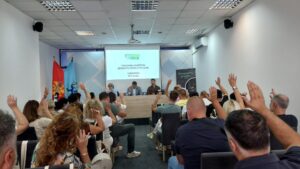
foto: SMCG
Marijana Camović Veličković, previously served as a member of the Main Board and vice-president of the organisation. From 2013 to 2022, she served as president of the Trade Union of Media of Montenegro. She also served two terms as a member of the Steering Committee of the European Federation of Journalists and was a member of the Montenegrin Government’s Commission for Monitoring the Actions of Competent Authorities in Investigations into Cases of Threats and Violence against Journalists, Murders of Journalists and Attacks on Media Property.
She is the author and co-author of dozens of studies and analyses on the Montenegrin media, the level of media freedom and other issues relevant to the sector. She is a freelance journalist and has written for several regional news portals in recent years. She is also a member of several working groups that have worked, or are currently working, on amendments to legislation in Montenegro.