

 By
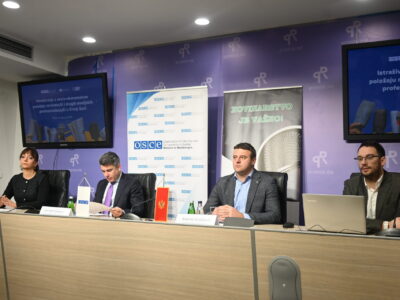
By A total of 33 attacks against media workers were recorded in Montenegro in 2025, marking the highest number since records have been kept. This was announced at the forum “Dignified Conditions for Responsible Journalism”, organised by the Media Trade Union of Montenegro (SMCG) and the Media Institute ahead of 23 January, Journalists’ Day in Montenegro.
SMCG President Radomir Kračković stated that the safety of media workers significantly deteriorated over the past year, while political pressure persisted and intensified, and the economic position of journalists remained almost unchanged.
“In 2025, we recorded 33 attacks on journalists, which is an absolute record since we began monitoring these data. Particularly concerning is the fact that in 18 cases the victims were women journalists,” Kračković said, adding that Montenegro continued to fall in the Western Balkans Journalists’ Safety Index.
He noted that during the past year, SMCG worked together with institutions and the media community to establish a Journalists’ Safety Mechanism, which is expected to be put in place during the current year

foto: Institut za medije
“This mechanism will provide institutional, legal and psychological support to journalists who are attacked and will contribute to faster processing of cases and more adequate outcomes,” Kračković said.
Media Institute Director Olivera Nikolić stated that Montenegro is facing serious anti-democratic and anti-European trends that directly affect the state of the media.
“Despite laws and formal frameworks, democracy in practice remains weak, and the media environment poor—primarily due to the journalists’ unfavourable socio-economic position, the lack of collective agreements, and insufficient protection from threats and attacks,” Nikolić said.
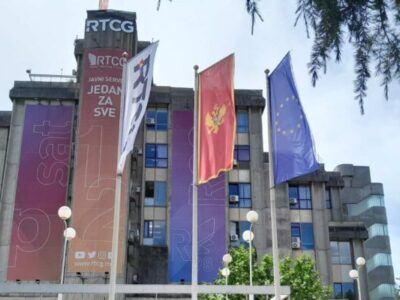
She warned that the independence and editorial autonomy of public broadcasters and media regulators are seriously undermined by constant political pressure, as seen during the selection of members of the RTCG Council and the Agency for Audiovisual Media Services (AMU).
Nikolić also recalled the pressures faced by RTCG employees who are fighting for better labour rights.

foto: Institut za medije
“Among other things, employees of this media outlet are even threatened with the Public Broadcaster’s Code of Ethics, which should serve to fulfil the institution’s core mission, not as a tool for disciplining the disobedient. The Media Institute conducted an analysis of the RTCG Code of Ethics, which, due to its restrictive and, in some respects, threatening tone, deviates from the spirit of self-regulation. We will submit this analysis to the Council of the broadcaster, together with a proposal to amend the disputed provisions and adopt new ones through the broadest possible consensus among employees,” she said.
She also highlighted that work is underway on amendments to the Code of Ethics for Journalists of Montenegro, aimed at adapting it to the changing digital media environment. Nikolić added that the Media Institute and SMCG are actively working on improving the Code, a process initiated by the Council of Europe and the OSCE Mission.
SMCG Vice President Marijana Camović Veličković said that the union conducted the first-ever research on the position of women journalists during the year.
“The prevailing impression among women journalists is that they are unprotected and cannot rely on support from their newsrooms. Legal assistance is often denied, psychological support is provided by almost no newsroom, while security protocols either do not exist or are not implemented,” Camović Veličković said.

foto: Institut za medije
She added that 2025 was also marked by strong anti-union discrimination, particularly at RTCG and RTV Podgorica, where at least 100 employees left the union under pressure.
“Management-controlled unions were formed, while those who fought for employees’ rights were exposed to pressure and dismissals. This is a dangerous trend, especially because such pressure has shifted from private to public media,” she warned.
Nova M journalist Željka Mirković emphasised the importance of solidarity within the profession, citing the example of journalists working in the field in Botun, where colleagues agreed to leave the site together if they were not given statements by local residents.

Foto: Institut za medije Crne Gore
“It is not acceptable to wait for hours without information, nor for some media to receive statements while others are sidelined. We are in the field for the citizens, not merely to hold microphones. If we do not demonstrate solidarity and professional resistance ourselves, we cannot expect others to respect us,” Mirković said.
Journalist Duško Mihailović also stressed the importance of solidarity, noting that journalists in the field are most often supportive of one another.
“They share information and help each other in crisis situations. In the past, it was not uncommon for us to boycott events if certain politicians were late or behaved inappropriately toward colleagues. That practice is slowly returning,” he said.
RTCG journalist Snežana Radusinović said that the union at the public broadcaster has been negotiating a collective agreement for over a year without clear results.
“People who produce programmes are working for minimum wages. Under such conditions, it is difficult to talk about dignity and responsible journalism,” she said, adding that “disobedient” journalists had been exposed to pressure, transfers, and the cancellation of programmes.
Photojournalist Stevo Vasiljević recalled that the attack on him and his colleague Boris Pejović, which occurred during the removal of a monument to Chetnik commander and war criminal Pavle Đurišić in Gornje Zaostro, has still not been resolved.
“We do not know who is responsible or who gave the order. Working conditions are deteriorating, and our work is being systematically undervalued,” he said.
According to him, the conditions in which journalists and photojournalists work are continuously worsening, primarily due to poor economic conditions and the lack of respect for professional work.

Foto: Institut za medije Crne Gore
“Our work is often underestimated, and the core problem is that we lack financial resources and do not know how to protect what we produce. Very few media outlets truly produce original information, while almost everyone else republishes it, which prevents us from valuing and protecting our work. If we want to defend ourselves as a profession, we must first respect ourselves—by signing our work, insisting on respect for copyright, and producing high-quality content that we know how to protect and publish,” Vasiljević said.
Photojournalist Boris Pejović stressed that copyright is the foundation of media outlets’ financial stability.
“In our country, copyright is not respected—photos are used by anyone, and working for minimum wages is highly demotivating,” he said.
He added that the attack on him and his colleague in Gornje Zaostro was prosecuted, but that in practice attacks on journalists often go without resolution.
“I cannot say that I am fully satisfied, but every step forward and every prosecuted case should be welcomed. The problem is that too often no one is held accountable,” Pejović said, adding that far more effort is needed to prevent attacks on journalists.
President of the RTV Podgorica Trade Union Milan Nikčević, who was dismissed due to his union activities, assessed that there is a lack of solidarity and collegiality within the media community.
“Politicians and institutions are there because of us, not the other way around. Until we understand that, we will remain weak,” he said.

Journalist Vesna Rajković Nenadić said that in the case of pressures she faced from Danijela Mujović, the wife of the Mayor of Podgorica, she received strong support from colleagues, civil society organisations and the public.
“I am deeply professionally proud and personally grateful for that support,” she said.
Journalist Predrag Tomović stated that working for foreign media spared him from many of the problems journalists in Montenegro face today

Foto: Institut za medije Crne Gore
“There were clear standards and working conditions, while here the greatest asset of the media—people—is often neglected,” Tomović said.
He stressed that media outlets must invest more in young journalists and colleagues who, despite difficult conditions, have managed to develop knowledge and expertise in their respective fields.
Vijesti correspondent from Kolašin, Dragana Šćepanović, pointed to the marginalised position of correspondents.
“We work without logistical support, from our own homes, are available 24 hours a day, and salaries are very low. These are just some of the reasons why the position of correspondents needs to be strengthened systemically,” she said.